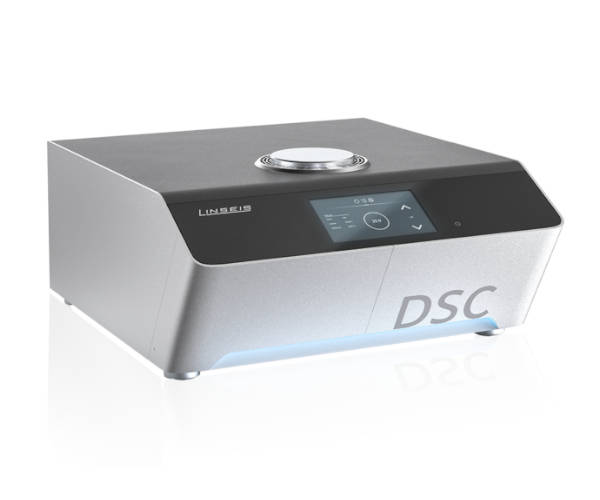
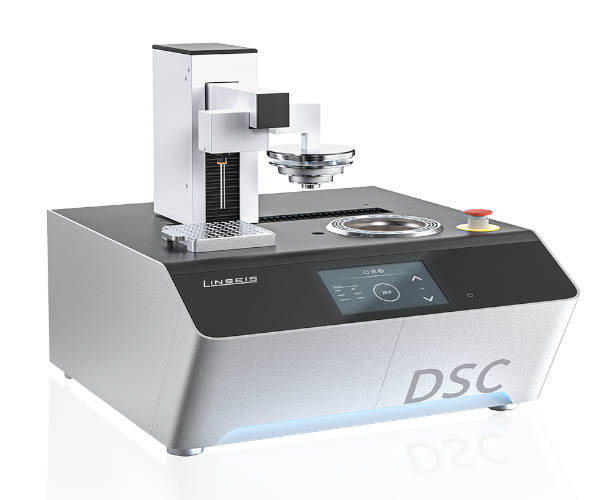

LINSEIS DSC L63 – HIGH-PERFORMANCE DIFFERENTIAL SCANNING CALORIMETER
Unmatched Sensitivity and Versatility for Advanced Thermal Analysis
The Linseis DSC L63 is a benchmark in thermal analysis, engineered to provide precise insights into the endothermic and exothermic transitions of materials. As a central tool for research, development, and quality control, the DSC L63 delivers unsurpassed sensitivity and resolution, making it ideal for detecting even the weakest transitions in complex samples.
Whether you are characterizing polymers, pharmaceuticals, or inorganic substances, the DSC L63 provides high-significance data as a function of temperature and time.
Key Features & Advantages
- Widest Temperature Range: Achieve seamless analysis from -170°C up to 750°C in a single measurement without needing to adjust cooling options.
- Unsurpassed Sensitivity: Specially designed to detect subtle melts and weak transitions that other systems might miss.
- Benchmark Resolution: Exceptional signal separation allows for the precise distinction of closely occurring thermal events.
- Modulated DSC (MDSC) Capability: Separate complex heat flows into reversible (glass transitions, melting) and non-reversible (crystallization, relaxation) components for deeper material insight.
- Reliable Automation: Increase lab productivity with an optional 90-position autosampler that enables autonomous operation overnight or over weekends.
- Flexible Hardware Options: Customize your system with UV curing capabilities for photo-calorimetry or a CCD camera for real-time sample visualization during testing.
Versatile Applications Across Industries
The Linseis DSC L63 is the preferred solution for identifying critical material properties:
- Polymers: Analyze glass transition (Tg), crystallinity, melting behavior, and curing kinetics.
- Pharmaceuticals: Determine purity, stability, and polymorphic transitions.
- Food Science: Study the melting behavior of fats and protein denaturation.
- Chemicals & Metals: Investigate oxidation stability (OIT), specific heat capacity (Cp), and solidification behavior.
Intelligent Software for Streamlined Workflows
The DSC L63 is powered by intuitive software that simplifies data acquisition and evaluation. Key software benefits include:
- LiEAP Guidance: Automated tools for evaluating melting and crystallization points.
- Thermal Library: An optional identification tool with a comprehensive database for automatic material recognition.
- Multi-Language Support: User-selectable versions including English, Chinese, and more.
REQUEST A QUOTE / ENQUIRY FORM
SPECIFICATIONS
BROCHURE
SPECIFICATIONS
| Feature | Basic | Advanced | Ultimate |
| Temperature range | -170°C to 600°C | -170°C to 750°C | -170°C to 750°C |
| Heating rates | 0.01 to 100 K/min | 0.01 to 150 K/min | 0.01 to 150 K/min |
| Temperature Precision | ±0.2 K | ±0.2 K | ±0.02 K |
| Enthalpy Precision | < 1% (Indium) | < 0.2% (Indium) | < 0.2% (Indium) |
| Baseline Flatness | – | ≤ 10 µW | ≤ 10 µW |
BROCHURE
| LINSEIS DSC L63 Product Brochure |
DIFFERENTIAL SCANNING CALORIMETRY
Menu

