Understanding Contact Angle Measurement: Principles, Methods and Applications
Introduction
How easily does a liquid spread across a solid surface? Does a coating provide good wettability? Can a surface treatment improve the adhesion of paint, ink or adhesive?
These questions are important in industries such as plastics, automotive, electronics, coatings, packaging, pharmaceuticals and advanced materials manufacturing.
These questions are important in industries such as plastics, automotive, electronics, coatings, packaging, pharmaceuticals and advanced materials manufacturing.
Contact angle measurement is a widely used technique for evaluating the wettability of solid surfaces and understanding their interactions with liquids. By measuring the angle formed between a liquid droplet and a solid surface, researchers and quality-control professionals can obtain valuable information about surface properties, surface treatments and material compatibility.
Contact angle analysis is also used to estimate the surface free energy of solid materials, providing further insight into adhesion, coating performance, printing, cleaning and other surface-related processes.
This guide explains the principles of contact angle measurement, common measurement methods, industrial applications and factors to consider when selecting a contact angle measuring instrument.
1. What Is Contact Angle Measurement?
Contact angle measurement is a technique used to characterize the wettability of a solid surface by measuring the angle formed at the three-phase boundary where a solid, liquid and surrounding gas meet.
When a small liquid droplet is deposited onto a solid surface, its shape depends on the interaction between the liquid and the surface.
When a small liquid droplet is deposited onto a solid surface, its shape depends on the interaction between the liquid and the surface.
- A liquid that spreads easily generally forms a small contact angle.
- A liquid that remains as a rounded droplet generally forms a larger contact angle.
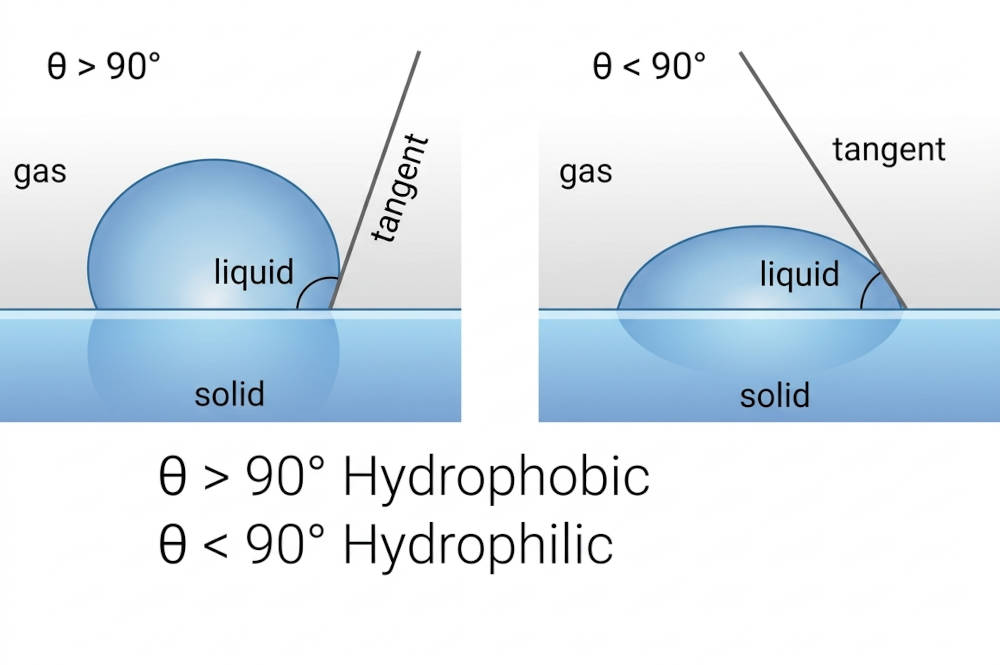
The contact angle is commonly represented by the Greek letter theta (θ) and measured in degrees.
Understanding Contact Angle Values
Contact angle values are commonly interpreted as follows:
| Contact angle | Surface wettability | General interpretation |
| θ = 0° | Complete wetting | Liquid spreads completely |
| θ < 90° | Good wettability | Liquid spreads relatively easily |
| θ = 90° | Intermediate wettability | Neither strong wetting nor strong non-wetting |
| θ > 90° | Poor wettability | Liquid tends to remain as a droplet |
| θ approaches 180° | Very poor wettability | Extremely limited liquid-solid contact |
Important: These ranges are general interpretations for conventional contact angle measurements. The actual wetting behaviour depends on the solid-liquid system, surface condition, measurement method and experimental environment.
2. Scientific Principles Behind Contact Angle
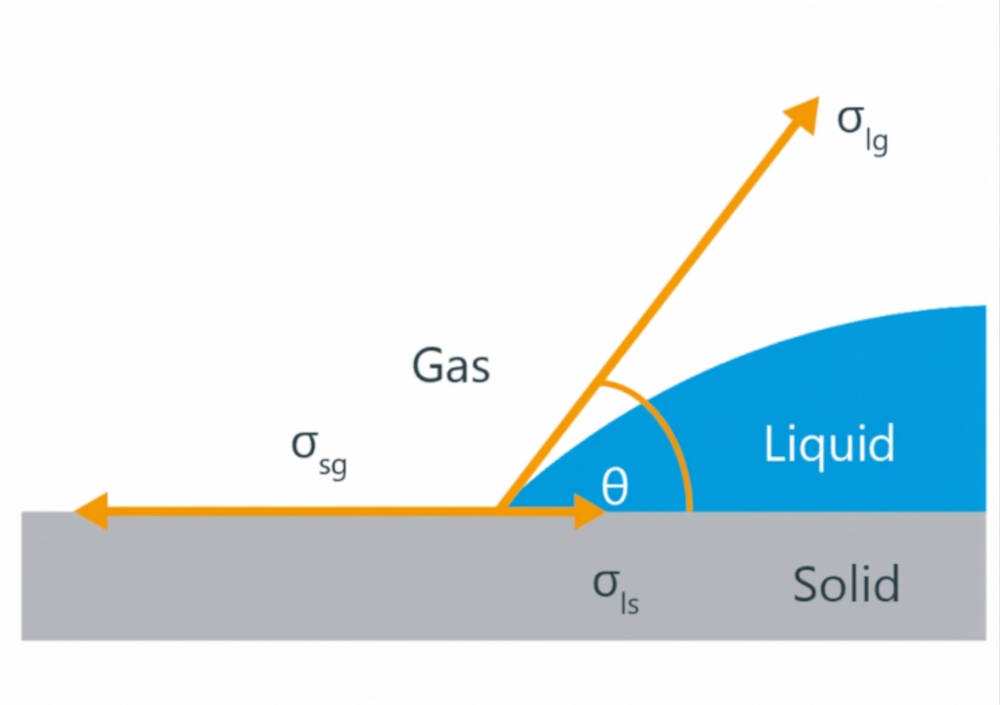
Contact angle is governed by the balance of interfacial tensions between three phases:
- Solid-gas interfacial energy (γSG)
- Solid-liquid interfacial energy (γSL)
- Liquid-gas surface tension (γLG)
For an ideal, smooth, chemically homogeneous and non-reactive solid surface under equilibrium conditions, Young’s equation describes the relationship:
γSG = γSL + γLG cos θ
Where:
- γSG = solid-gas interfacial energy
- γSL = solid-liquid interfacial energy
- γLG = liquid-gas surface tension
- θ = equilibrium contact angle
Young’s equation provides the theoretical foundation for understanding how liquids interact with solid surfaces.
In practical measurements, however, real materials may exhibit surface roughness, chemical heterogeneity, contamination and contact angle hysteresis. These factors can cause measured contact angles to differ from ideal equilibrium values.
In practical measurements, however, real materials may exhibit surface roughness, chemical heterogeneity, contamination and contact angle hysteresis. These factors can cause measured contact angles to differ from ideal equilibrium values.
3. Hydrophilic vs Hydrophobic Surfaces
One of the most common applications of contact angle measurement is distinguishing between hydrophilic and hydrophobic surfaces.
Hydrophilic Surfaces
Hydrophilic surfaces have a relatively strong affinity for water, allowing water droplets to spread more easily.
They generally exhibit water contact angles below 90°.
They generally exhibit water contact angles below 90°.
Typical examples include:
- Clean glass surfaces
- Certain metal oxide surfaces
- Hydrophilic polymer coatings
- Plasma-treated polymer surfaces
Hydrophobic Surfaces
Hydrophobic surfaces exhibit relatively low affinity for water, causing droplets to remain more rounded.
They generally exhibit water contact angles above 90°.
They generally exhibit water contact angles above 90°.
Typical examples include:
- Certain fluoropolymer materials
- Water-repellent coatings
- Silicone-based surfaces
- Hydrophobic-treated textiles
Contact angle measurement allows manufacturers and researchers to evaluate surface modifications and verify whether a treatment produces the intended wettability characteristics.
4. Common Contact Angle Measurement Methods
Different measurement methods are available depending on the material, sample geometry and testing objectives.
4.1 Sessile Drop Method
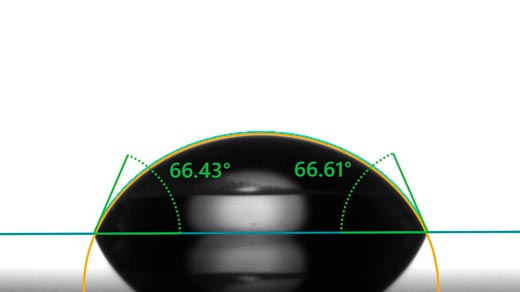
The sessile drop method is one of the most widely used techniques for contact angle measurement.
A small liquid droplet is deposited onto a solid surface using a dispensing system. A camera captures the droplet profile, and image analysis software determines the contact angle at the solid-liquid-gas interface.
A small liquid droplet is deposited onto a solid surface using a dispensing system. A camera captures the droplet profile, and image analysis software determines the contact angle at the solid-liquid-gas interface.
Typical applications include:
- Polymer surface characterization
- Coating wettability
- Surface treatment evaluation
- Adhesion studies
- Material research and development
Advantages:
- Relatively straightforward measurement procedure.
- Suitable for a wide range of flat solid samples.
- Allows direct observation of droplet behaviour.
- Can be used to evaluate static and dynamic contact angles.
4.2 Pendant Drop Method
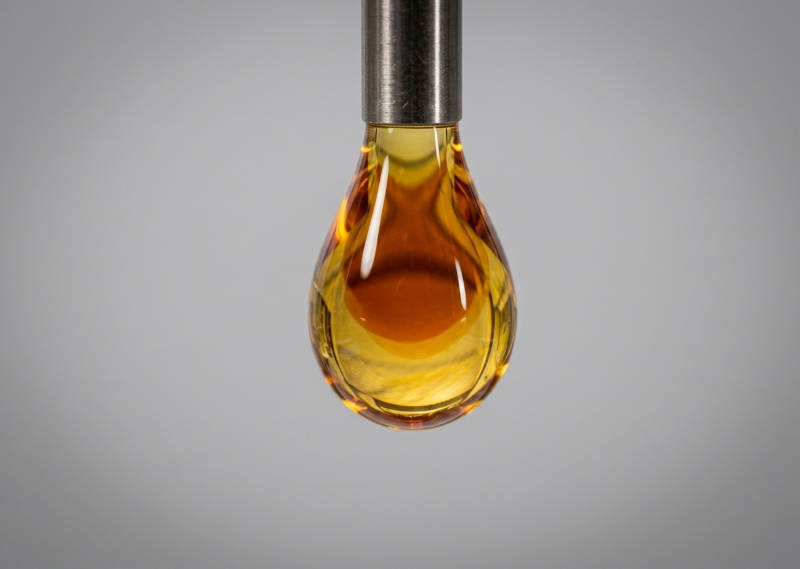
The pendant drop method involves suspending a liquid droplet from the tip of a needle.
The droplet shape is analysed based on its gravitational deformation and the Young-Laplace equation to determine liquid surface tension or interfacial tension.
Unlike the sessile drop method, pendant drop analysis is primarily used to characterize liquid surface and interfacial properties rather than directly measuring the wettability of a solid surface.
Typical applications include:
- Liquid surface tension measurement
- Oil-water interfacial tension
- Surfactant research
- Formulation development
- Chemical and pharmaceutical research
4.3 Wilhelmy Plate Method
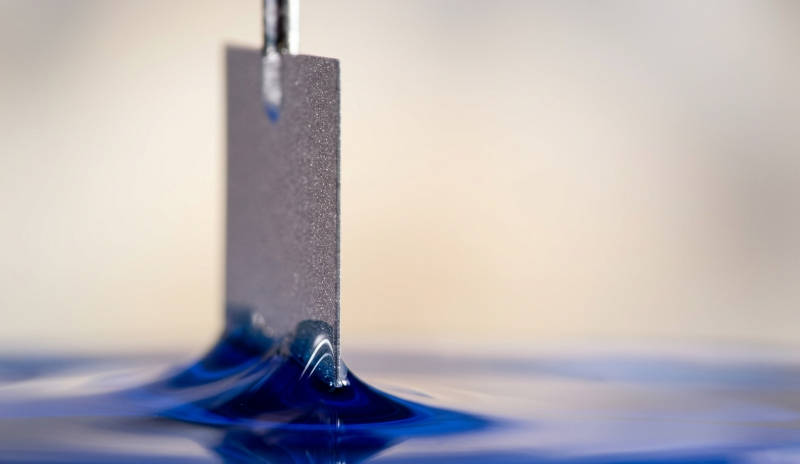
The Wilhelmy plate method is a force-based measurement technique used to determine the surface tension of liquids and the interfacial tension between two liquid phases. It works by measuring the force exerted on a thin, vertically suspended plate as it comes into contact with or is immersed in a liquid.
The measured force is used to calculate surface or interfacial tension. With a suitable experimental configuration, the method can also be used to determine the contact angle and evaluate the wettability of solid surfaces.
The measured force is used to calculate surface or interfacial tension. With a suitable experimental configuration, the method can also be used to determine the contact angle and evaluate the wettability of solid surfaces.
Typical applications include:
- Measurement of liquid surface tension
- Measurement of liquid–liquid interfacial tension
- Determination of contact angle on suitable solid samples
- Evaluation of solid–liquid wettability and surface interactions
4.4 Dynamic Contact Angle Measurement
Dynamic contact angle measurement evaluates how contact angle changes as the liquid-solid contact line moves.
Two important measurements are:
Two important measurements are:
- Advancing contact angle: The contact angle measured as the liquid contact line advances over the solid surface.
- Receding contact angle: The contact angle measured as the liquid contact line withdraws from the solid surface.
The difference between these values is known as contact angle hysteresis.
Dynamic measurements provide additional information about surface heterogeneity, roughness and liquid-solid interactions.
Dynamic measurements provide additional information about surface heterogeneity, roughness and liquid-solid interactions.
5. What Is Surface Free Energy?
Contact angle measurement can also be used to estimate the surface free energy of solid materials.
Surface free energy is an important property when evaluating how a solid surface interacts with liquids, coatings, adhesives and other materials.
Surface free energy is an important property when evaluating how a solid surface interacts with liquids, coatings, adhesives and other materials.
It is particularly useful in understanding:
- Adhesion performance
- Printing and ink transfer
- Paint and coating application
- Polymer surface treatment
- Bonding and lamination
- Surface cleaning and modification
How Is Surface Free Energy Determined?
The surface free energy (SFE) of a solid cannot usually be measured directly. Instead, it is calculated from contact angle measurements using different theoretical models. These models estimate the surface energy of a solid by analysing its interaction with liquids of known surface tension.
Commonly used models include:
Commonly used models include:
Owens-Wendt-Rabel-Kaelble (OWRK) Model
The OWRK model divides surface free energy into two components:
The OWRK model divides surface free energy into two components:
- Dispersive component – associated with non-polar interactions, such as van der Waals forces.
- Polar component – associated with polar interactions, including hydrogen bonding and dipole interactions.
It is widely used for evaluating the surface energy of polymers, coatings, plastics and other solid materials.
Fowkes Model
The Fowkes model considers the dispersive component of surface free energy and estimates it from interactions between the solid and liquid. It is particularly useful for analysing surfaces where dispersive interactions are dominant.
The Fowkes model considers the dispersive component of surface free energy and estimates it from interactions between the solid and liquid. It is particularly useful for analysing surfaces where dispersive interactions are dominant.
Wu Model (Harmonic Mean Method)
The Wu model uses the harmonic mean approach to calculate the polar and dispersive components of a solid’s surface free energy from contact angle measurements. It considers the contributions of both components to solid–liquid interactions.
The model is commonly applied to polymer surfaces, coatings and other materials where both polar and dispersive interactions are significant. It is particularly useful for evaluating surface treatments and adhesion-related properties.
Choosing the Appropriate Model
The choice of model depends on the material, the nature of its surface interactions and the intended application. OWRK and Wu are commonly used for polymer and coating surfaces, while the Fowkes model is useful when dispersive interactions are of primary interest.
For reliable results, measurements should be performed using suitable test liquids with known surface tension components and carefully controlled experimental conditions.
6. Industrial Applications of Contact Angle Measurement
Contact angle analysis is used across many industries to evaluate surface properties and improve product performance.
Plastics and Polymer Industry
Contact angle measurement helps evaluate:
- Surface modification of polymer films
- Plasma and corona treatment effectiveness
- Polymer wettability
- Adhesion properties
- Printing and coating performance
For example, manufacturers of plastic packaging films may use contact angle measurements to assess whether surface treatment improves ink adhesion and printing quality.
Paints and Coatings Industry
Contact angle measurements help evaluate:
- Coating wettability
- Surface preparation effectiveness
- Paint spreading behaviour
- Protective coating performance
- Surface contamination
Automotive Industry
Applications include:
- Paint and clear-coat wettability
- Surface treatment of automotive components
- Adhesive bonding evaluation
- Water-repellent surface coatings
- Surface cleanliness assessment
Electronics and Semiconductor Industry
Contact angle analysis is useful for:
- Wafer surface cleanliness evaluation
- Photoresist coating processes
- Surface preparation
- Thin-film coating applications
- Cleaning process validation
Textile Industry
Contact angle measurements can help evaluate:
- Water-repellent textile treatments
- Fabric wettability
- Hydrophilic textile coatings
- Moisture management properties
Pharmaceutical Industry
Applications include:
- Powder wettability
- Tablet coating research
- Surface properties of pharmaceutical materials
- Liquid-solid interactions in formulation development
For powders and porous materials, appropriate measurement techniques such as capillary rise or Washburn-based methods may be more suitable than conventional sessile drop analysis.
7. Factors Affecting Contact Angle Measurement Accuracy
Reliable contact angle measurements require careful sample preparation and controlled testing conditions.
Important factors include:
Important factors include:
- Surface cleanliness
Dust, oil, fingerprints and other contaminants can significantly influence wettability. Samples should be cleaned using a method appropriate for the material without unintentionally changing its surface chemistry. - Surface roughness
Surface texture can affect the apparent contact angle. Roughness may increase or decrease the measured angle depending on the wetting regime and surface characteristics. - Droplet volume
Droplet size can influence the measurement, particularly on surfaces with heterogeneous chemistry or texture. Consistent droplet dispensing is important for repeatability. - Liquid properties
The purity, temperature and surface tension of the test liquid can affect the measurement. Deionized water is commonly used for water contact angle measurements. - Environmental conditions
Temperature, humidity and evaporation can influence measurements. Consistent environmental conditions help improve reproducibility. - Measurement time
Some surfaces exhibit time-dependent wetting behaviour due to absorption, swelling, surface rearrangement or chemical interactions. The measurement time should therefore be controlled and reported. - Image analysis and instrument calibration
Reliable droplet imaging, appropriate baseline detection, optical alignment and suitable image-fitting methods are important for obtaining consistent contact angle results.
8. How to Select a Contact Angle Measuring Instrument
Selecting a suitable contact angle measuring instrument depends on your testing requirements, sample characteristics and intended applications.
Consider the following factors:
Consider the following factors:
| Selection factor | What to consider |
| Measurement methods | Sessile drop, pendant drop, advancing/receding contact angle |
| Sample type | Films, plastics, metals, glass, coatings, fibres |
| Sample dimensions | Maximum sample size and measurement area |
| Optical system | Camera resolution, lens magnification and image quality |
| Dispensing system | Manual or automated droplet dispensing |
| Measurement software | Automatic contour detection and contact angle calculation |
| Surface energy analysis | Availability of suitable calculation models |
| Temperature control | Requirements for temperature-dependent testing |
| Automation | Need for automated measurements and repeatability |
9. Contact Angle Measurement Solutions from DataPhysics Instruments
DataPhysics Instruments develops scientific instruments for surface and interfacial analysis, including contact angle measurement, surface tension and interfacial tension characterization.
Depending on the testing requirements, its instrument range offers solutions for evaluating solid surface wettability, determining surface free energy and characterizing liquid surface properties.
LMS Scientific Solution Sdn Bhd provides DataPhysics Instruments in Malaysia, supporting customers in identifying suitable measurement configurations for research, material characterization and industrial quality-control applications.
Explore the DataPhysics Instruments range:
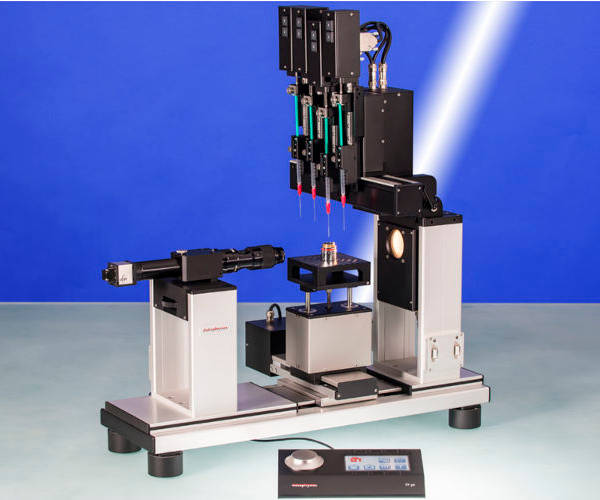
Optical Contact Angle and Surface Tension Measuring Instruments
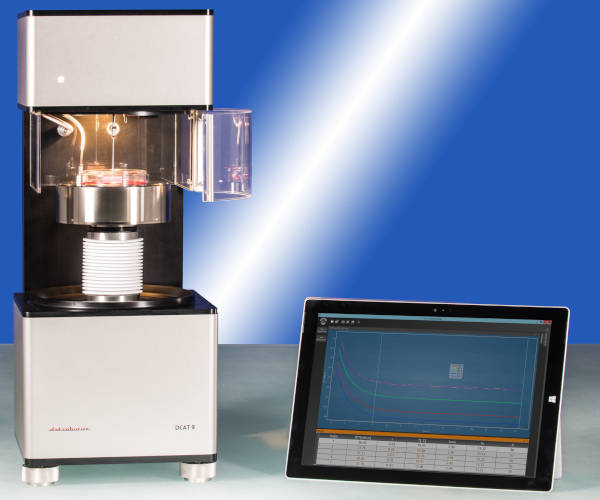
Dynamic Contact Angle and Tensiometry Solutions
10. Frequently Asked Questions (FAQs)
Contact angle measurement is used to evaluate the wettability of solid surfaces by determining how a liquid droplet interacts with the surface. It is commonly used in coating, adhesion, polymer processing and surface treatment applications.
There is no universally ideal contact angle. The required value depends on the application. For example, good water wettability is often desirable for certain coating and cleaning processes, while hydrophobicity is preferred for water-repellent surfaces.
Contact angle describes the wetting behaviour of a liquid on a solid surface, whereas surface tension describes the energy associated with the surface of a liquid. Contact angle measurements can be used together with known test-liquid properties to estimate the surface free energy of solids.
Yes. Surface free energy can be estimated using contact angle measurements with two or more suitable test liquids, depending on the selected calculation model and its assumptions.
Advancing contact angle is measured when the liquid contact line moves forward over a solid surface, while receding contact angle is measured when it moves backwards. The difference between them is called contact angle hysteresis.
An optical contact angle measuring instrument is commonly used for sessile drop and dynamic contact angle measurements. The appropriate model depends on sample size, required measurement methods, automation and surface characterization requirements.
Conclusion
Contact angle measurement is an important analytical technique for understanding surface wettability, liquid-solid interactions and surface free energy.
From polymer films and protective coatings to electronics, textiles and pharmaceutical materials, this measurement technique helps researchers and manufacturers evaluate surface properties and improve material performance.
Choosing the appropriate measurement method and instrument is essential for obtaining reliable and meaningful results.
For laboratories looking to establish or improve their surface characterization capabilities, LMS Scientific Solution Sdn Bhd can assist in identifying suitable DataPhysics measurement solutions based on specific application and testing requirements.